National Financial Educator Standards and Financial Literacy Standards in Africa

Advancing Educator Competency to Improve Financial Literacy Outcomes

The NFEC created the first comprehensive framework designed specifically to help financial educators elevate the quality and effectiveness of financial literacy instruction. These guidelines outline the essential personal finance knowledge educators should possess across all major content areas, along with the instructional practices proven to support strong learning outcomes.

The goal behind developing these standards was to make a publicly accessible resource that educators and organizations could rely on to strengthen financial capability and improve the longterm results of financial education initiatives. Notably, these standards represent the first and only set tailored for African financial educators.

Research consistently demonstrates that learners taught by wellprepared instructors experience significantly better outcomes. They retain more of what they learn, earn more over their lifetimes, enjoy greater retirement security, and report higher levels of overall wellbeing. In contrast, students taught by lessqualified educators tend to see fewer positive results. Those who learn from highly-skilled instructors can expect advantages such as increased lifetime earnings, stronger financial stability later in life, and improved mental and physical health.

Accredited & Independent

As the only Accredited Provider in the financial education space to establish industry standards for financial educators in Africa, the NFEC sets the benchmark for excellence in teaching personal finance. Our framework reflects proven best practices for educators – covering instructional design, learner-centered methods, measurable outcomes, and professional ethics – so organizations and learners can trust the quality of instruction delivered by instructors.

Importantly, the NFEC developed these standards independently, without sponsorship or outside funding that might shape content or priorities. That independence ensures that our standards are driven solely by what produces real learning and behavior change – clear, defensible, and focused on measurable impact for learners, employers, and communities
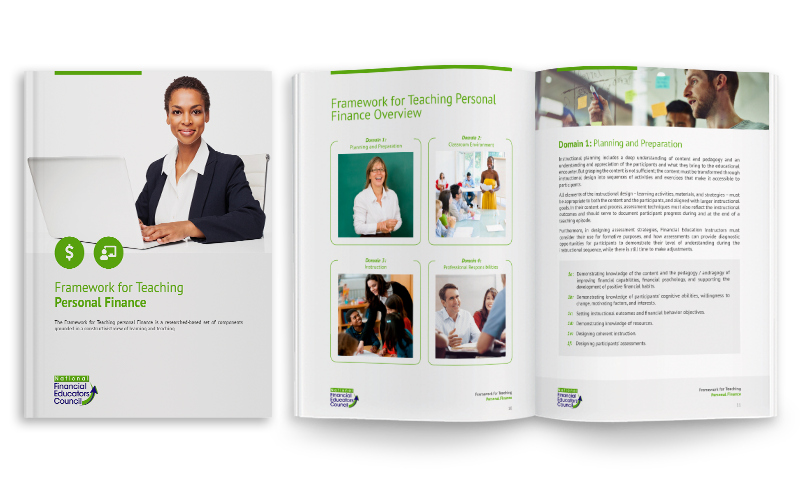
Standards for Financial Education Practitioners – Framework for Teaching Personal Finance

The NFEC created the Framework for Teaching Personal Finance, the first internationally recognized set of professional standards designed specifically for financial education instructors. This Framework lays out clear, actionable benchmarks that strengthen instructional quality and help learners build practical money management skills they can use in everyday life.

Developed in collaboration with the Danielson Group and a multidisciplinary team of experts in education, psychology, finance, and program evaluation, the Framework aligns with the InTASC core teaching standards. Drawing on Charlotte Danielson’s widely respected model and rooted in constructivist learning, it outlines 22 researchsupported components that define the knowledge, competencies, and observable behaviors effective instructors must demonstrate. Together, these elements form a roadmap that links highquality teaching practices to measurable learner progress.

The Danielson Framework is one of the most trusted instructional models in the United States, embraced by educators, administrators, and policymakers and adopted in more than 20 states. By adapting this proven structure for financial education, the NFEC brings the same rigor and accountability to the field on a global level – offering a standardsdriven approach that elevates instruction and documents real learner outcomes.

Certification Tour, Graduate Features, & Bonus Presentation Resources

  • CFEI® Tour: See how the program works and explore the journey step by step.

  • Graduate Features: Hear real stories from instructors making an impact.

  • Bonus Resources: Get exclusive teaching tools to elevate your financial education programs.

This is more than a course – it’s your opportunity to join a global network of educators committed to empowering individuals and communities with practical, life-changing financial skills.

By accessing the NFEC’s material, you agree to comply with the full terms.

Join Over 5,000 Enrolled CFEI® Champions Providing Others Qualified Financial Education

The NFEC Provides Standards for Financial Educators – The Groups Below Provide Standards for Learners

NFEC educator standards work in concert with student learning standards by ensuring that instructors are well-equipped to deliver content that aligns with defined financial capabilities and measurable results. Together, they create a comprehensive system where teaching caliber and learner accomplishments are directly connected.

National Financial Education Strategy (NFES)

Ghana

Lead organization:
Bank of Ghana and national financial sector stakeholders

Description:
Ghana has implemented national frameworks under its financial inclusion agenda to improve consumer capability, savings, insurance awareness, and responsible borrowing. While not a standalone statute, the national strategy functions as a financial education standards framework that guides coordinated financial literacy programming, especially for youth, women, and underserved communities. It supports broader financial sector reforms and consumer empowerment efforts.

National Financial Education Strategy (NFES) / National Strategy for Financial Education

 Kenya

Lead organization:
Central Bank of Kenya and financial sector regulators

Description:
Kenya has advanced financial capability through national policy frameworks connected to its financial inclusion agenda. The strategy promotes structured financial learning, digital financial skills, and consumer awareness, serving as a national benchmark for financial literacy standards across schools, communities, and financial institutions. The framework aligns financial education with digital finance growth and consumer protection priorities.

National Financial Inclusion Strategy (NFIS) – Financial Literacy Pillar

Nigeria

Lead organization:
Central Bank of Nigeria

Description:
Nigeria’s National Financial Inclusion Strategy explicitly incorporates financial literacy and consumer education as core pillars. Introduced in 2012 and updated over time, it established a national direction for financial education delivery and institutional coordination. This framework is widely treated as one of the country’s principal financial education standards mechanisms because it outlines priorities for capability building and inclusion.

Financial Literacy Framework (FLF)

Nigeria

Lead organization:
Central Bank of Nigeria

Description:
Nigeria’s Financial Literacy Framework, developed in 2013, provides structured guidance for implementing financial education programs among youth, adults, women, and underserved populations. Though not legislation, it effectively serves as a national financial literacy standards guide for educators, financial institutions, and public agencies delivering financial capability initiatives.

National Strategy for Financial Literacy

Uganda

Lead organization:
Bank of Uganda

Description:
Uganda launched a multi-stakeholder National Strategy for Financial Literacy to improve household financial decision-making, savings behavior, insurance awareness, and responsible credit use. The strategy acts as a coordinated national framework and has become central to discussions around financial education standards in East Africa, particularly for vulnerable populations and youth.

National Financial Inclusion Strategy (NFIS) – Consumer Financial Education Component

Zimbabwe

Lead organization:
Reserve Bank of Zimbabwe

Description:
Zimbabwe’s financial inclusion policy framework includes consumer financial education and capability building as major priorities. Although not codified as standalone legislation, the strategy provides a practical foundation for national financial literacy standards, especially for women, SMEs, and rural populations. Financial education is positioned as a tool for resilience and inclusion.

National Strategy on Financial Education (NSFE) 2012–2017

Zambia

Lead organization:
Bank of Zambia

Description:
Zambia’s first National Strategy on Financial Education established a coordinated framework for delivering financial capability programs nationwide. The strategy set goals for improving financial knowledge, consumer awareness, and financial behavior, effectively serving as the country’s foundational financial education standards framework. It aligned closely with broader financial sector development plans.

National Strategy on Financial Education (NSFE II) 2019–2024

Zambia

Lead organization:
Bank of Zambia and financial sector partners

Description:
Zambia updated its national strategy through NSFE II, expanding financial education delivery to children, youth, workers, and entrepreneurs. The framework emphasizes measurable outcomes and stronger institutional coordination, reinforcing national financial literacy standards for public and private stakeholders involved in financial capability training.

Consumer Protection Frameworks within Financial Sector Regulation

Nigeria

Lead organization:
Central Bank of Nigeria

Description:
Nigeria’s consumer protection policies complement national financial education efforts by requiring fair disclosure, complaints handling, and customer awareness. These frameworks reinforce practical financial education standards by improving consumer understanding of financial products and risks.

Financial Sector Development Plans with Financial Education Components

Zambia

Lead organization:
Bank of Zambia and Ministry of Finance

Description:
Zambia’s Financial Sector Development Plans have formally integrated financial education into financial sector reform. These plans support implementation of national financial literacy standards and help institutionalize financial education among regulators, schools, and financial service providers. (MFW4A – Making Finance Work for Africa)